Jan 5, 2026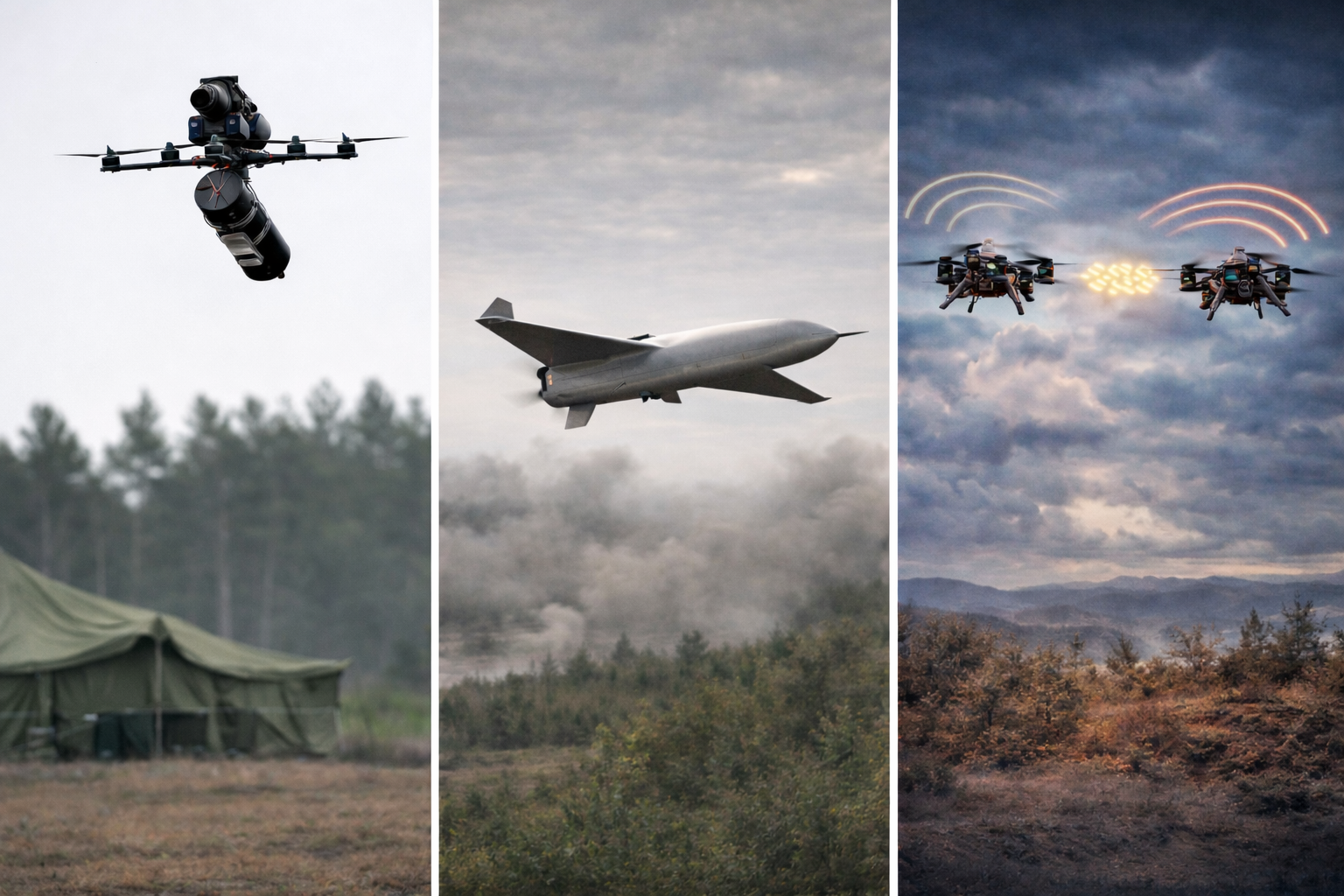
1. Introduction: The Growing Problem of Drone Jamming
Drones have become a defining technology of modern warfare. From reconnaissance and artillery spotting to precision strikes and supply drops, they are now central to how conflicts are fought and monitored. Nowhere has this transformation been more visible than in Ukraine, where thousands of small and mid-size drones are being deployed every month. Systems such as DJI Mavics, FPV kamikaze drones, and heavy-lift platforms like Baba Yaga quadcopters have become routine tools on the battlefield, while Russia’s Shahed-136 and other long-range loitering munitions have reshaped expectations about drone warfare at scale.
In reaction to the rise of drones, a new challenge has emerged to counter them: electronic warfare. Military and improvised jammers are targeting drones by flooding the airwaves with interference or spoofed signals. Once a control link or GPS signal is lost, many drones either crash or drift aimlessly. This has made anti-jamming innovation one of the most urgent areas of development for both defence and civilian sectors.
2. How Drone Jamming Works
At its core, jamming is about overpowering or confusing the signals a drone relies on. This applies to everything from small commercial quadcopters like the DJI Mavic to long-range one-way attack drones such as the Shahed-131/136, both of which rely heavily on RF links or GPS for navigation. Jamming can involve transmitting strong noise on the same frequency as the control or video channel, or broadcasting fake GPS coordinates to mislead navigation systems. Since most drones depend on radio communication for both control and telemetry, a single well-placed jammer can disable several aircraft at once.
To counter these threats, engineers have been developing technologies that either make communications immune to interference, replace them with onboard decision-making, or make them far more difficult to detect and disrupt. Three main approaches have emerged: fibre-optic tethering, onboard artificial intelligence, and frequency hopping.
3. Three Main Anti-Jamming Approaches for Modern Drones
Each of these methods tackle the same problem in a different way. Fibre-optic drones avoid using radio signals altogether. Onboard AI allows a drone to continue its mission even if every signal is blocked, a concept increasingly explored in Ukraine where some FPV strike drones are being given basic autonomous behaviours. Frequency hopping keeps wireless control possible but makes it unpredictable and harder to jam. Together they represent the three strategic directions shaping the next generation of resilient drones.
4. Fibre-Optic Tethered Drones: The Wired Anti-Jamming Solution
What Fibre-Optic Tethering Is and How It Works
A fibre-optic tethered drone remains physically connected to its operator through a lightweight optical cable. The cable carries digital control commands, sensor feeds, and power if required. These cables are often stored on a small spool that unreels as the drone ascends. The result is a direct, high-bandwidth connection that completely avoids the radio spectrum.
In Ukraine and other conflict zones, fibre-optic systems have been used for observation and targeting drones that must operate inside areas saturated with electronic warfare. These include improvised tethered systems supporting overwatch missions where normal RF-controlled drones such as Mavics or Baba Yaga-style heavy quadcopters would be instantly jammed. Instead of relying on radio frequencies that could be detected or disrupted, operators send data through the cable as light signals, immune to RF interference.
Advantages of Fibre-Optic Control
The primary advantage is immunity to jamming. Since no radio link exists, the drone cannot be affected by electronic noise or frequency attacks. The fibre also allows extremely high-speed data transfer, making it ideal for transmitting uncompressed video or sensor imagery. Another benefit is security: optical cables are difficult to intercept without physical access, which makes the connection highly secure for both military and industrial uses.
Limitations and Trade-Offs
The main drawback is range. Even with lightweight spools, the drone’s operating radius rarely exceeds a few kilometres. The cable adds weight and drag, limiting flight time and manoeuvrability. A tether also introduces the risk of entanglement and makes the drone unsuitable for fast-moving or long-range missions. Deploying and recovering the spool adds complexity that most field units try to avoid in mobile operations. The limited range created by the physical tether also presents an increased risk to the drone operator, as they are required to be much closer to the front line.
Summary: When Fibre Optics Make Sense
Fibre-optic tethering is a powerful solution for stationary surveillance or electronic warfare environments where radio links cannot survive. It trades range for absolute reliability. Ongoing research into micro-spools and hybrid RF-fibre systems could make this technology more practical in the future.
5. Onboard AI Decision-Making
What Onboard AI Means for Drones
Another way to eliminate the risk of jamming is to remove the need for live control altogether. By embedding artificial intelligence models within the drone, decisions about navigation, targeting, and obstacle avoidance can be made locally. The operator provides mission parameters before take-off, and the drone executes them autonomously.
In Ukraine, there are early examples of AI-driven systems that continue flying even after the control signal is lost. Some experimental FPV platforms and modified loitering munitions are being fitted with vision-based target recognition so they can complete their mission autonomously when jamming cuts the link. This experimentation is occurring alongside existing systems such as Shahed-type loitering munitions, which already rely heavily on pre-programmed flight paths and limited autonomy.
Advantages of AI Autonomy
Autonomous drones are unaffected by communication jamming or GPS denial because they rely on internal logic and sensors rather than external data links. They can react instantly to changing conditions, often faster than human operators. The absence of a constant radio signal also makes them harder to detect, since there is less electromagnetic activity for adversaries to track.
Challenges and Drawbacks
AI autonomy has its limits. True decision-making requires substantial onboard computing power, which increases cost, power consumption, and heat generation. Training AI models for unpredictable real-world environments remains difficult, and there are ethical concerns about letting machines make life-and-death decisions without human oversight. Another challenge is that fully autonomous drones are difficult to update or retask mid-flight once the communication link is severed.
Summary: The Future of Autonomous Anti-Jamming
Despite these challenges, onboard AI represents the long-term direction for anti-jamming resilience. As edge computing chips become more efficient, small drones will increasingly be able to make their own navigation and targeting choices without external input.
6. Frequency Hopping: Adaptive Communications for Anti-Jamming Drones
How Frequency Hopping Works
Frequency Hopping Spread Spectrum, or FHSS, takes a different approach. Instead of avoiding radio communication, the system continually shifts the transmission frequency. Both the transmitter and receiver hop between channels many times per second, following a synchronised but unpredictable pattern.
This makes it difficult for jammers to lock onto the signal. Even if a few frequencies are saturated with interference, the majority of the data still gets through. FHSS first appeared during the Second World War and has since become a standard method for resilient military and industrial communication.
Modern implementations have evolved considerably. HopSync, Beechat’s adaptive frequency-hopping system, builds on these principles by synchronising multiple nodes within a tactical mesh network. It helps radios maintain communication in heavily contested environments by dynamically coordinating their hopping behaviour across the entire network. You can read our dedicated HopSync article for a deeper look at how the algorithm coordinates hopping across multiple nodes.
Advantages of FHSS
The biggest advantage is flexibility. Drones can retain long-range wireless control without being easily jammed. Frequency hopping also makes interception difficult, since the signal appears scattered and unpredictable. When combined with encryption, it offers strong protection against eavesdropping. FHSS can be layered onto mesh networking so that even if one link is blocked, the network as a whole continues to function.
Limitations and Design Challenges
Frequency hopping depends on the transmitter and receiver staying aligned on the same hopping pattern. If their timing drifts too far apart, packets start to miss and the link can degrade or drop until synchronisation is recovered. Although FHSS reduces the impact of jamming, it cannot completely eliminate it, especially when high-power broadband noise covers most of the band. Civilian systems may also be constrained by regulation, which limits which frequencies and how wide a hopping set they are allowed to use.
Newer designs try to reduce these synchronisation problems. HopSync, for example, removes the need for continuous sync beacons by deriving hop positions from time and a shared secret, and it can resynchronise passively if a node drifts. The underlying dependency on timing is still there, but the practical risk of losing sync is lower than in traditional FHSS implementations.
Summary: The Practical Middle Ground
Frequency hopping is increasingly used in mission profiles where drones such as reconnaissance quadcopters, long-range FPV drones, or tactical loitering munitions must maintain control links in contested areas. For most operational drones, frequency hopping provides the best balance between range, mobility, and resilience. It does not require tethers or heavy onboard processors, and it allows dynamic adaptation to changing conditions. As algorithms improve, FHSS remains one of the most practical defences against modern jamming.
7. Comparing the Three Anti-Jamming Approaches
| Approach | Signal Type
|
Strengths | Weaknesses | Typical Use |
| Fibre-optic tether | Wired | Completely immune to jamming, secure, high bandwidth
|
Limited range, heavy, complex | Surveillance and EW zones |
| Onboard AI | None | Independent of communication or GPS
|
High cost, ethical limits, hard to retask | Loitering or autonomous strike drones |
| Frequency hopping | Wireless | Long range, flexible, proven technology
|
Needs synchronisation, still jam-susceptible at extreme power | Tactical mesh networks and mobile operations |
8. Conclusion: The Future of Anti-Jamming Drone Design
There is no single perfect solution to the jamming problem. Fibre-optic tethers offer total protection but restrict movement. Onboard AI enables true autonomy but raises ethical and technical challenges. Frequency hopping remains the most balanced and widely deployable option for now.
The ongoing conflict in Ukraine has accelerated experimentation in all three areas, turning theory into field-tested reality. Over the next few years, expect to see hybrid systems that blend these methods: drones that use frequency hopping for long-range control, switch to AI autonomy when jammed, or rely on fibre-optic tethers for stationary overwatch missions.
As technology matures, anti-jamming will no longer be a specialist feature but a standard requirement for any operational drone, whether military or civilian. The race to build resilient communication links is reshaping how drones are designed, deployed, and defended.
Last updated: January 2026
Sources:
https://www.cigionline.org/articles/drone-technology-is-transforming-warfare-in-real-time/
https://jatm.com.br/jatm/article/view/1396
https://pmc.ncbi.nlm.nih.gov/articles/PMC11244045/
https://www.mdpi.com/2504-446X/9/6/425
https://asiapacificdefencereporter.com/fibre-optic-drones-in-ukraine-a-tactical-experiment/
https://www.mdpi.com/2504-446X/7/5/322
Contact information:
Web: beechat.network
Sales inquiries: sales@beechat.network
Technical support: outreach@beechat.network